Data-Driven Management: Statistics for Managers

Data-Driven Management: Statistics for Managers
This is a multi-output teaching line built around a textbook, lecture decks, companion site, worked examples, instructor resources, and episode materials. It is designed for reproducible teaching, adoption, and course delivery.
At a glance
- 27 chapters across 8 parts
- 27 lecture decks and worked examples
- Companion website, datasets, and downloads
- Instructor resources and episode materials
Positioning
Data-Driven Management: Statistics for Managers is the most mature textbook line in the FlairMI portfolio. The live public deployment already exists, and the underlying source project is structured to support teaching, adoption, and multi-format delivery from a shared asset base.
Who It Is For
This teaching line is written for management and business students who need to use statistics to make decisions, not to specialise as statisticians. It fits undergraduate and postgraduate learners, instructors who want a reproducible teaching workflow, and readers who prefer applied business examples over abstract mathematical treatment.
Prerequisite Knowledge
The book assumes basic comfort with percentages, tables, and introductory business concepts. It does not depend on advanced mathematics. R-based examples and supporting materials are included so that instructors and self-directed learners can move from explanation to practical analysis without building a course stack from scratch.
Book Structure
The textbook currently spans 27 chapters across eight parts:
- Foundations
- Describing Data
- Probability
- Relationships
- Estimation
- Hypothesis Testing Logic
- Core Tests
- Interpretation and Decision Use
Sample Outputs
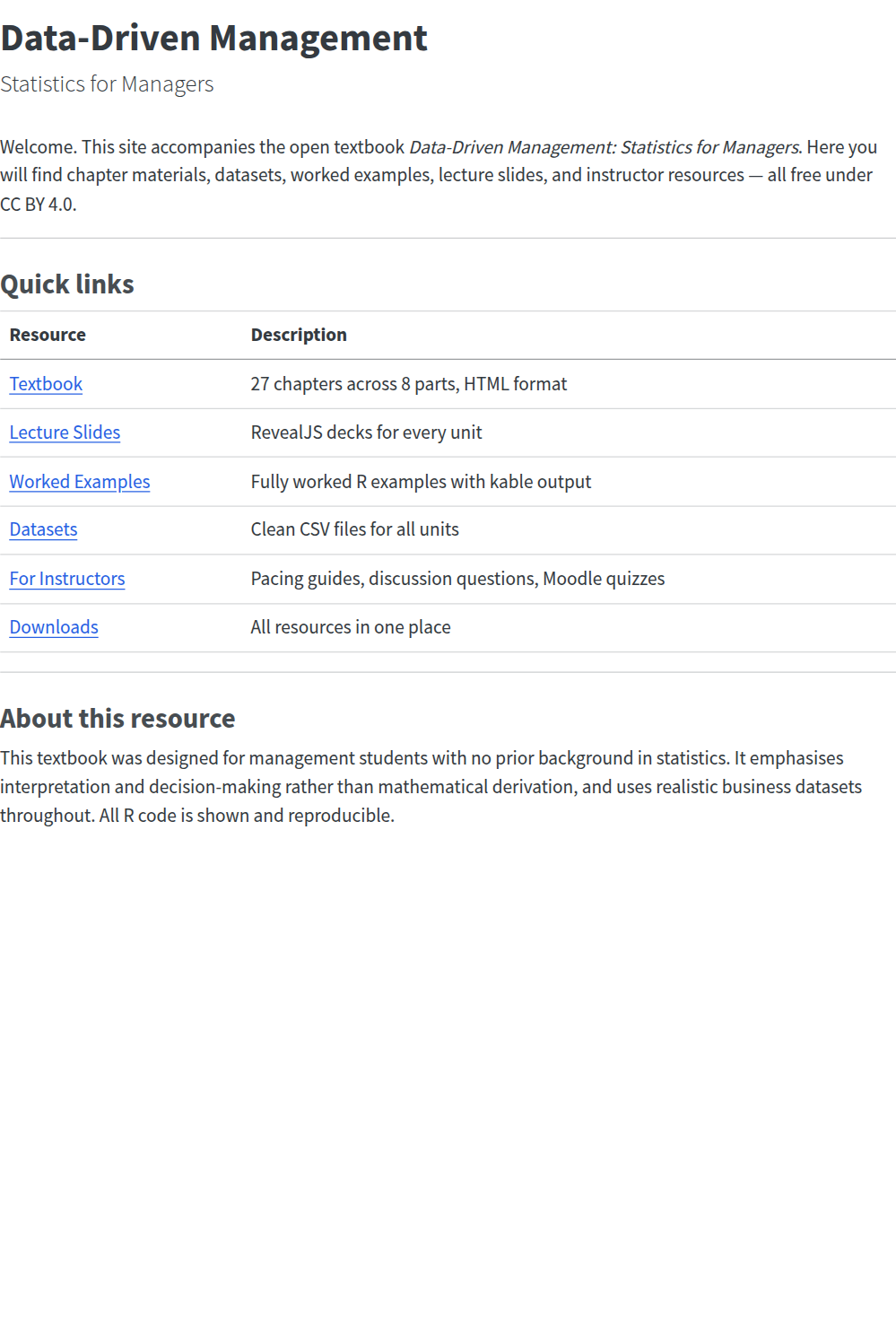
Companion Site Overview
The public DDMM companion site brings together the textbook, slides, worked examples, datasets, instructor-facing materials, and download routes in one teaching hub.
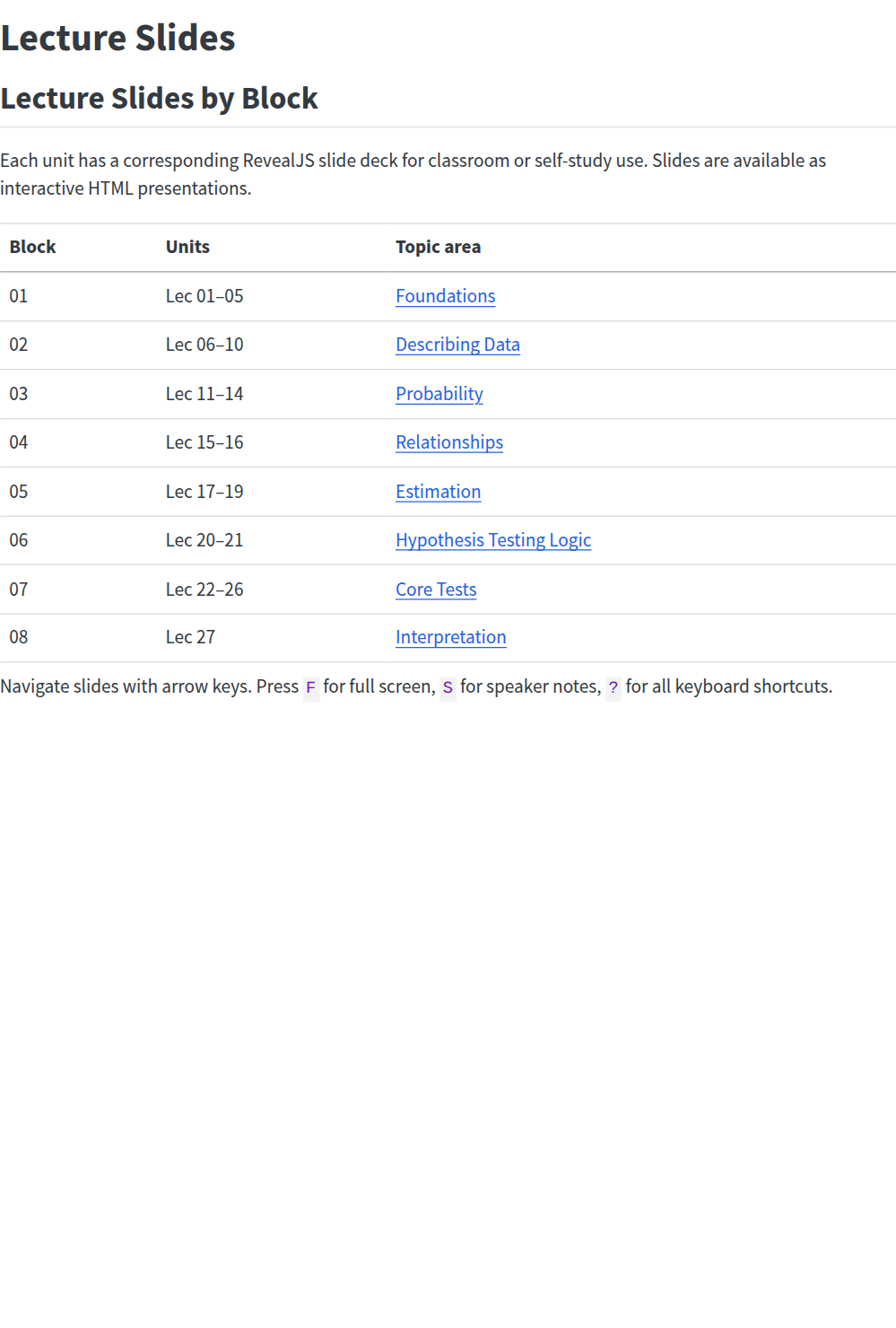
Lecture Slides And Teaching Outputs
The lecture-slides index shows the block-by-block RevealJS decks that support the teaching sequence, from foundations to interpretation and decision use.
What You Can Use Today
- The live companion site provides the public-facing entry point for the textbook and related materials.
- The broader DDMM suite includes 27 lecture decks, worked examples, datasets, and instructor-oriented assets.
- The project is designed as a teaching system rather than a single book file, so course delivery, examples, slides, and supplementary outputs move together.